Many educators and parents feel helpless when faced with the behavioral challenges presented by kids with special needs or Autism Spectrum Disorder (ASD). At igivuwings, we provide research-based, practical strategies that help you effectively deal with these challenges. We put YOU in control!

Consulting and Professional Development that Puts You in Control!
Learn to Effectively Manage Meltdowns and other Behavior Challenges Presented by Kids with Special Needs or Autism Spectrum Disorder
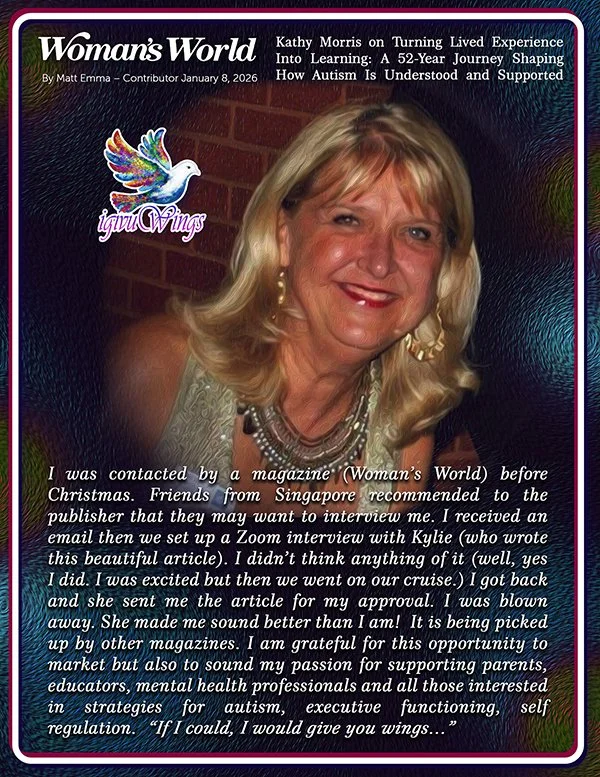
Woman’s World Interview….
I was contacted by a magazine (Woman’s World) before Christmas. Friends from Singapore recommended to the publisher that they may want to interview me. I received an email then we set up a Zoom interview with Kylie (who wrote this beautiful article). I didn’t think anything of it (well, yes I did. I was excited but then we went on our cruise.) I got back and she sent me the article for my approval. I was blown away. She made me sound better than I am! it is being picked up by other magazines. I am grateful for this opportunity to market but also to sound my passion for supporting parents, educators, mental health professionals and all those interested in strategies for autism, executive functioning, self regulation.
“If I could, I would give you wings…” ~ Kathy Morris

Get the Help You Need, ASAP!
Many educators and parents feel helpless when faced with the behavioral challenges presented by kids with special needs or Autism Spectrum Disorder (ASD). At igivuWings, we provide research-based, practical strategies that help you effectively deal with these challenges. We put YOU in control!
We Know everyone’s situation is different—So we offer training and consulting in a variety of formats
Customized Virtual Consulting and Coaching Services
Personalized Consultations and coaching for Individuals and Teams.
Workshops are great, but sometimes you just need to talk with an expert face-to-face or virtually. Lucky for you, we provide this service, too!
Here’s what you’ll get when you sign up for consulting or coaching:
You and Kathy will talk through your classroom challenges together.
You’ll receive in-depth resources, advice, and intervention ideas.
You’ll walk away from the consultation or coaching session with a doable, easy-to-manage plan.
You’ll get your classroom or entire program pointed in the right direction, starting in less than 48 hours.
Live and Virtual Workshops
Workshops for Your Team, Department, School, or Entire District!
Popular Topics:
"What to Do After the Meltdown: Prevention, Intervention, and Post-Vention Strategies” (also comes in pre-K to 1st and teen versions)
“Why Can’t They Get This Done? Over 25 Supports for Addressing Executive Function Breakdowns in Children and Adolescents” (can be tailored for any grade range)
"Happy for No Reason: 7 Steps to Being Happy from the Inside Out”
“Make Way! Including Our Students with Moderate to Severe Disabilities in a General Education Classroom”
“Help Your Students Develop Self-Regulation Skills to Improve Behavior and Increase Learning in 3 to 5-Year-Olds”
We Understand that Your Job is Tough
Do you sometimes feel helpless when a young person with special needs or ASD loses control?
Do you often feel frustrated and wonder, “What am I doing wrong?”
Do you sometimes feel like you’re not “pulling your weight” as part of the team of people working with a child with special needs?
Would you like to learn a host of practical, proven strategies that put YOU in control?
If you answered “Yes” to any of the questions above, give us a call so we can start helping you right away!

We customize workshop topics and consultations to address your specific needs.
You don’t need to be confused or frustrated anymore!

Kathy Morris
Kathy Not Only Teaches It, She Lives It!
At igivuWings, we know what it feels like to try so hard to help a child with special needs and still have things go wrong from time to time. We know the helplessness you sometimes feel when that child has a meltdown. We know the frustration you sometimes feel when cognitive/developmental disorders or executive functioning breakdowns make learning so hard for the student. And we know how lonely it can feel when others are looking at you to “handle it” and you don’t know what to do.
Kathy Morris, owner and lead trainer at igivuWings, understands how you feel because not only has she worked with kids with special needs and ASD in school and clinical settings for years, but she also has sons of her own with these challenges. Kathy’s oldest son, Guy V, is a gifted speaker and special education teacher. Her twin sons, Kirk and Drew, have Fragile X Syndrome and Autism Spectrum Disorders. Kirk also has cerebral palsy. Bottom line, Kathy not only teaches it, she lives it!
“Wonderful, engaging, and positive learning experience! Listening to her personal stories made me feel that I had a connection to her as a parent and educator. Teachers need to take her seminars to gain the knowledge they will need to build a successful classroom for students who are ASD! Best workshop I have ever attended!”

Our Simple “3 Steps to Mastery” Plan
1. Schedule an Appointment (your initial consultation is 100% free)
2. Get Your Customized Plan (we will co-create the perfect plan for your situation)
3. Execute Your Plan (we will help you put your plan in motion and be there to help you troubleshoot)
BONUS Step 4: Have Greater Success Than You Ever Dreamed Of!
All the Training You Need—None of the Fluff You Don’t
At igivuWings, we know you’re the kind of person who cares deeply about kids with special needs and wants to help them live their best lives. To do that, you need to be cool, confident, and competent in the challenging situations that often arise.
The problem is, you don’t always have all the answers when, for example, a child has a meltdown—which makes you feel frustrated, even helpless.
We believe that every person who works with kids with special needs should have access to the most effective, research-based, and easy-to-implement strategies, but we understand that you may not have had the opportunity to receive this high-quality training in the past.
That’s why we distill decades of experience into our consulting and training. We cut out all the fluff you sometimes get in a training situation (have you experienced that? Thought so!) and share with you just the very best, proven strategies.
Here’s how it works:
You call us and schedule an appointment for a free consultation.
We work together to create a customized action plan.
We deliver the training and help you implement the plan.
That’s it!
So don’t wait. Call us today so you can stop stressing over what you’re going to do the next time a child has a meltdown. Get the training you need to be fully in control of the situation—no matter what happens!


Our “Competent and Confident” Guarantee
We believe that people with special needs deserve to be treated with respect and love. We also believe that they deserve to have well-trained, competent teachers and caregivers who can help them live their best lives. If you agree, allow us to guide you on your journey to becoming a knowledgeable, highly-effective professional. We promise to give you all the research-based strategies you need to become both highly competent and supremely confident in your new-found skills.